PRP Spine and Joint
PRP stands for platelet rich plasma. Your blood contains red cells, white cells, serum and platelets, and while platelets are best known for forming clots, medical research has shown they also carry a range of proteins and chemicals directly involved in wound healing. When platelets are activated, they release these components, collectively known as growth factors.
When blood cells are separated out, the fluid that remains is plasma. Processing that plasma concentrates the platelets and their growth factors into a small volume, which is then mixed with a buffer and anticoagulant and injected into the injured tissue. In essence, your physician concentrates your own healing factors and delivers them back into the area that needs them.
- Uses your own blood
- No surgery required
- Image guided precision
- Outpatient procedure
- Steroid free approach
- Low allergic risk
- Physician administered

What PRP Treats, And Why It Is Different
This approach works very differently from anti inflammatory medication and steroid injections. Those reduce inflammation, which also means they suppress part of the healing response. PRP aims to do the opposite: it delivers growth factors that support repair in tissue that has struggled to heal on its own. The procedure is performed as an outpatient under sterile conditions.
Commonly treated: knee, hip and shoulder osteoarthritis, facet joint and sacroiliac joint pain, discogenic low back pain, chronic tendon injuries including tennis and golfer's elbow, rotator cuff irritation, and lingering ligament sprains.
Draw
A small blood sample is taken from your arm, exactly as it would be for a routine lab test. The draw takes only a few minutes.
Concentrate
The sample is processed to separate and concentrate the platelets and their growth factors, then prepared with anticoagulant for injection.
Inject
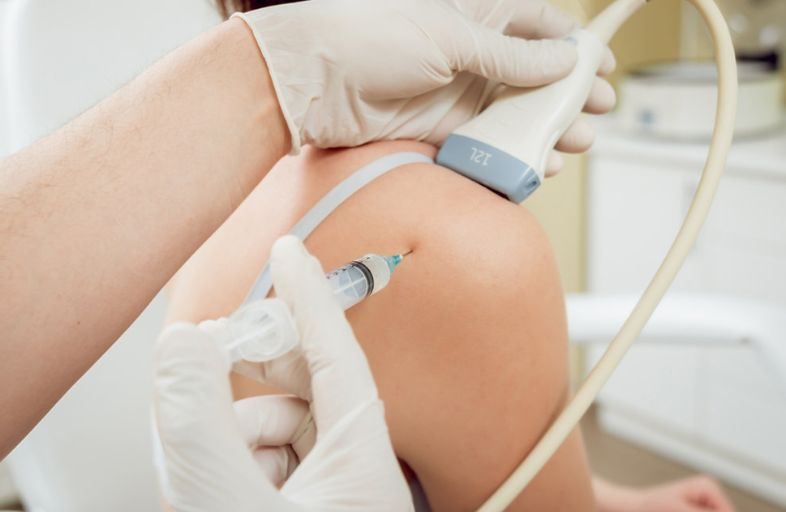
Using ultrasound or fluoroscopy, your physician places the concentrate precisely into the injured joint, tendon or spinal structure under sterile conditions.
Frequently asked questions
A cortisone injection reduces inflammation and often relieves pain quickly, but the relief fades and repeated injections can weaken tendon and cartilage over time. PRP works more slowly and aims to support repair in the tissue itself. Many patients come to us specifically because cortisone has stopped helping.
The injection site is numbed first. It is normal to feel increased soreness and stiffness for two to five days afterwards, because the treatment deliberately triggers a healing response. Most people return to desk work the next day. We will ask you to avoid anti inflammatory medication during recovery, as it works against the process.
It depends on the tissue and how long the problem has been present. Many patients do well with two to three injections spaced three to six weeks apart. Chronic, long standing cases sometimes need more. Your physician will give you a realistic estimate at consultation rather than after you have committed.
Because PRP supports your body's own repair process, change is gradual rather than immediate. Many patients begin noticing improvement between four and eight weeks, with continued progress over three to six months. We schedule follow ups to track your response rather than relying on impressions.
Good candidates typically have mild to moderate joint or tendon degeneration and have tried conservative treatment without lasting relief. Certain blood disorders, active infections, and some cancers rule it out. If your imaging shows damage that genuinely needs surgical repair, we will tell you rather than sell you a treatment that will not help.